
Mesotherapy for Hair Loss: How This Scalp Treatment Helps Restore Thicker, Healthier Hair
Waking up to a pillow covered in hair is unsettling. Running your fingers through your hair and feeling it thin between your fingers? Even worse. If you’ve been quietly panicking about hair loss, you’re not alone. Millions of people deal with thinning hair every single day, and most of them just want one thing: a real solution that actually works.
That’s where mesotherapy for hair loss comes in. It’s not a miracle cure wrapped in fancy marketing. It’s a clinically backed, minimally invasive scalp treatment that’s quietly gained serious traction among dermatologists and hair restoration specialists worldwide. And if you haven’t heard of it yet, you’re about to find out why so many people are talking about it.
What Is Mesotherapy for Hair Loss?
Mesotherapy is a medical aesthetic procedure that delivers a customised blend of vitamins, minerals, amino acids, and growth factors directly into the scalp through a series of microinjections. The technique was originally developed in France in the 1950s by Dr. Michel Pistor, primarily for pain management. Over time, practitioners discovered its remarkable potential for scalp rejuvenation therapy and hair regrowth, and the treatment evolved significantly from there.
Think of it this way. Your hair follicles sit beneath the surface of your scalp, where they depend entirely on proper blood flow and nutrition to stay healthy and active. When that supply gets disrupted, whether through stress, hormonal changes, or genetics, follicles weaken and hair starts to thin. Mesotherapy works by essentially bypassing the surface and feeding your scalp directly at the root level.
The injections are shallow, targeting the mesoderm layer of the scalp, which is exactly where follicles need the most support. It’s precise, targeted, and far more efficient than applying topical products that often struggle to penetrate deep enough to make a real difference.
Common Causes of Hair Loss and Alopecia

Before diving deeper into how the treatment works, it helps to understand why hair falls out in the first place. Hair loss isn’t one-size-fits-all. There are several distinct triggers, and knowing yours matters when choosing the right approach.
Androgenetic alopecia, commonly called pattern baldness, is the most widespread cause. It affects both men and women and is largely driven by genetics and the hormone dihydrotestosterone (DHT). Over time, DHT shrinks hair follicles until they stop producing hair altogether. Treatment for androgenetic alopecia often requires a multi-pronged strategy, and mesotherapy fits neatly into that picture.
Telogen effluvium is another common culprit. This type of hair loss is typically triggered by physical or emotional stress, nutritional deficiencies, illness, or hormonal shifts such as postpartum changes. The good news is that this kind is often reversible with the right intervention and support.
Alopecia areata is an autoimmune condition where the body mistakenly attacks its own hair follicles, causing patchy hair loss. Then there’s traction alopecia, which results from prolonged tension on the hair from tight hairstyles. Scalp inflammation, fungal infections, and thyroid imbalances also play a role for many people.
Understanding your specific cause is the first step. A dermatologist or hair specialist can evaluate your scalp and determine which treatment plan makes the most sense for your situation.
Read More: Types of Acne Scars: Rolling Scars, Boxcar Scars, Ice Pick & How to Treat Each
How Mesotherapy Works to Stimulate Hair Growth
Here’s where it gets genuinely interesting. Mesotherapy for hair loss works through multiple biological mechanisms simultaneously, which is part of why it tends to produce visible results where other treatments fall short.
When the cocktail of nutrients is injected directly into the scalp, several things happen at once. Blood circulation in the treatment area improves almost immediately. Better circulation means more oxygen and nutrients reaching the follicles, which is exactly what weak or dormant follicles need to wake back up and resume their growth cycle.
The active ingredients also work to inhibit the production of DHT locally around the follicles. This is particularly valuable for people dealing with genetic hair loss, since DHT is a primary driver of follicle miniaturisation. By reducing DHT at the source, the treatment helps slow further thinning while simultaneously encouraging regrowth.
Beyond that, the microinjections themselves stimulate a mild healing response in the scalp tissue. Your body interprets the tiny punctures as minor trauma and responds by sending growth factors and collagen-building compounds to the area. This natural repair process supports follicle regeneration and improves the overall health of the scalp environment.
What makes scalp microinjection therapy particularly compelling is its directness. Oral supplements take weeks to circulate through your system before reaching the scalp. Topical treatments fight against the skin barrier. Mesotherapy skips all of that and puts the nutrients exactly where they need to be.
Ingredients Used in Hair Mesotherapy Injections
The exact formulation varies depending on the clinic and the patient’s needs, but most hair mesotherapy cocktails share a core set of active components. These aren’t random ingredients. Each one serves a specific purpose in the hair regrowth process.
Biotin, also known as vitamin B7, is one of the most well-known nutrients used in hair follicle stimulation treatment. It supports keratin production, which is the structural protein your hair is literally made of. Without adequate biotin, strands become brittle and growth slows considerably.
Minoxidil is frequently included as well. You might know it from over-the-counter topical products, but when delivered via injection directly into the scalp, its vasodilatory effects are more concentrated and targeted. It widens blood vessels in the scalp, encouraging better circulation to follicle roots.
Zinc and selenium play vital roles in reducing scalp inflammation and supporting hormonal balance at the follicular level. Both deficiencies have been directly linked to hair thinning in clinical research.
Amino acids such as cysteine and methionine provide the raw building blocks for keratin synthesis. Hyaluronic acid is also commonly included to hydrate the scalp tissue and improve the structural environment around follicles. Peptides and plant-based growth factors may be added depending on the formulation, designed to signal follicular cells to shift from a resting phase back into an active growth phase.
Some advanced formulations also incorporate platelet-rich plasma (PRP) components or growth factor concentrates for patients who need more intensive support. Your practitioner will assess your scalp health and personalise the blend accordingly.
Key Benefits of Mesotherapy for Hair Loss
So why are more people turning to this approach? The benefits are both practical and clinically meaningful, especially for those who’ve already tried other methods without satisfying results.
One of the most immediate benefits is improved scalp health. Many people notice reduced itching, flaking, and inflammation within the first few sessions. A healthier scalp environment directly supports better hair growth, so this alone is a significant win.
Mesotherapy for hair loss also stimulates dormant follicles. This means hair that’s been in a prolonged resting phase can be coaxed back into active growth. For people experiencing diffuse thinning, this translates to noticeably improved hair density over a course of treatment.
It’s non-surgical, which matters enormously to a large portion of people considering hair restoration procedures. There’s no downtime, no general anaesthesia, no recovery period. Most people walk in, have their session, and carry on with their day. That accessibility makes it a viable option for people who aren’t ready for or interested in surgical intervention.
The treatment is also highly customisable. Because the formulation can be tailored to individual needs, it works for a range of hair loss types and severities. Whether you’re dealing with early-stage thinning or more advanced alopecia, the blend can be adjusted accordingly.
For people managing treatment for genetic hair loss, mesotherapy offers a complementary approach that works alongside other therapies rather than replacing them. It’s the kind of treatment that enhances your overall hair care strategy rather than demanding you abandon everything else.
The Mesotherapy Treatment Procedure: Step-by-Step
Knowing exactly what to expect before you walk into a clinic makes the whole experience far less daunting. The mesotherapy treatment procedure is straightforward, and most sessions take between 30 and 60 minutes from start to finish.
Your appointment typically begins with a scalp assessment. The practitioner will examine your scalp, review your hair loss history, and discuss your goals. This is also when they’ll finalise the specific formulation to be used in your session.
Next, the scalp is cleansed thoroughly to remove any product buildup or oils that might interfere with the procedure. A topical numbing cream may be applied beforehand, particularly for patients who are more sensitive. Most people find the discomfort quite manageable even without numbing, though this varies individually.
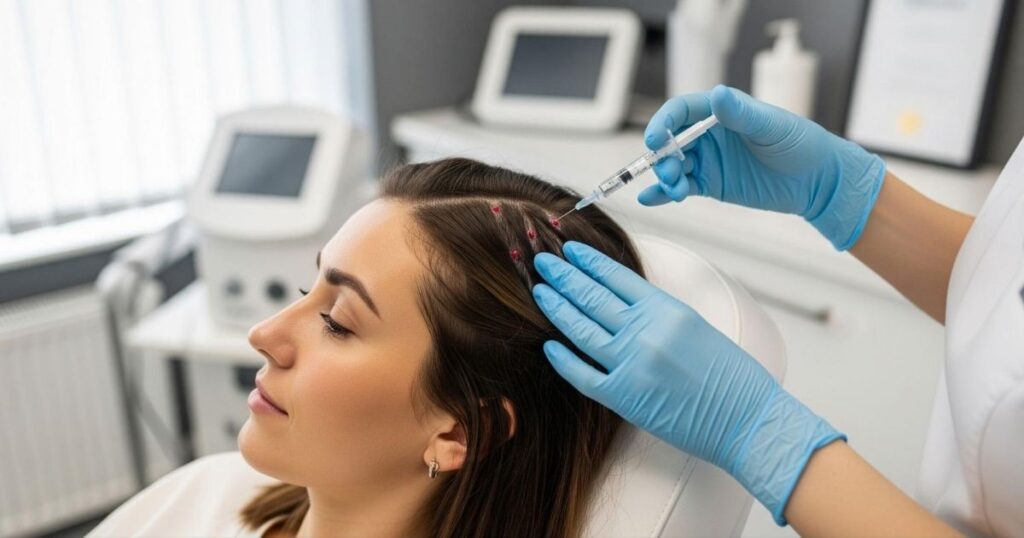
The injections are then administered using a fine-gauge needle or a mesogun, which is a device that delivers multiple microinjections consistently and efficiently. The needle penetrates only a few millimetres into the scalp, targeting the mesoderm layer where follicles reside. The practitioner works across the thinning areas systematically, ensuring even distribution of the solution.
After the injections are complete, the scalp may feel slightly tender or warm for a few hours. Some patients notice minor redness or pinpoint bruising, both of which typically resolve within 24 to 48 hours. You’ll generally be advised to avoid washing your hair, exercising vigorously, or exposing your scalp to direct heat for the remainder of the day.
Who Is a Good Candidate for Hair Mesotherapy?
Mesotherapy isn’t for everyone, and a good practitioner will be upfront about that. But the treatment is suitable for a broader range of people than many other hair restoration options.
Men and women experiencing early to moderate hair thinning tend to respond best. If your follicles are still active but struggling, mesotherapy gives them the nutritional and circulatory boost they need to function properly again. People dealing with diffuse thinning across the scalp, rather than complete bald patches, typically see the most satisfying improvements.
Those with androgenetic alopecia, telogen effluvium, or stress-related hair loss are considered strong candidates. People with nutritional deficiencies that have contributed to their hair thinning also respond very well, since the treatment directly replenishes what the follicles have been missing.
However, the treatment isn’t recommended for women who are pregnant or breastfeeding. People with active scalp infections, blood clotting disorders, or known allergies to any of the ingredients in the formulation should consult their doctor before proceeding. Those with advanced alopecia, where follicles have completely shut down over large areas, may find that mesotherapy alone isn’t sufficient and might need to consider combining it with other dermatological hair therapy options.
Age is generally not a limiting factor. Both younger adults experiencing premature thinning and older patients dealing with age-related hair loss can benefit from the procedure.
How Many Mesotherapy Sessions Are Needed?
This is one of the most common questions, and the honest answer is: it depends. But there are general guidelines that most practitioners follow.
For most patients, an initial course of six to ten sessions is recommended. These are typically spaced one to two weeks apart during the active phase. This frequency ensures that the scalp receives consistent stimulation and nutrient delivery while the follicles are being coaxed back into their growth cycle.
After completing the initial course, the frequency drops considerably. Most people move to monthly maintenance sessions to preserve and build on their results. Some patients with milder thinning may be able to extend that to once every six to eight weeks once their hair health has stabilised.
Results from hair mesotherapy don’t appear overnight. Most patients start noticing reduced shedding after the second or third session, which is often one of the earliest and most reassuring signs that the treatment is working. Visible improvements in hair thickness and density generally become apparent after four to six sessions.
How many mesotherapy sessions for hair loss you’ll ultimately need also depends on the severity of your condition, your age, overall health, and how consistently you attend your appointments. A personalised treatment plan from your practitioner will give you a much clearer picture of what to expect on your specific timeline.
How Long Do Mesotherapy Results Last?
This is where expectations need to be set clearly. Mesotherapy delivers real, visible results, but it’s not a permanent solution. Think of it more like a high-performance maintenance treatment than a one-time fix.
With a full initial course followed by regular maintenance sessions, most patients sustain noticeable improvements in hair density and scalp health for one to two years. Some people continue seeing cumulative benefits with ongoing treatment over longer periods.
If you stop treatment entirely, the benefits will gradually diminish. The underlying cause of your hair loss doesn’t disappear, so without continued support, the scalp eventually returns to its previous state. This is especially true for people with androgenetic alopecia, where genetic and hormonal factors continue exerting pressure on the follicles.
The good news is that mesotherapy pairs well with other long-term strategies. Using it alongside clinically proven topical treatments, maintaining a nutrient-rich diet, managing stress, and following a good hair care routine all contribute to longer-lasting results. Mesotherapy before and after results can be quite dramatic when the treatment is combined with a comprehensive approach to hair health.
Mesotherapy vs Other Hair Loss Treatments
People often want to know how mesotherapy stacks up against the other options on the market. It’s a fair question, and the comparison is genuinely useful for making an informed decision.
Mesotherapy vs minoxidil treatment is a common comparison. Minoxidil, sold under brand names like Rogaine, is a topical vasodilator applied directly to the scalp. It’s been around for decades and has solid clinical backing. However, it needs to be used indefinitely, and many people experience regrowth that fades quickly if they stop. Mesotherapy can actually incorporate minoxidil as one of its injected ingredients, delivering it more precisely than surface application allows. Some patients find combining both gives them better results than either approach alone.
When comparing mesotherapy vs hair transplant, the distinction is significant. A hair transplant is a surgical procedure involving the relocation of hair follicles from a donor area to thinning regions. It offers more dramatic, permanent results for advanced baldness. But it’s costly, invasive, and requires significant recovery time. Mesotherapy is far less aggressive and works best for earlier-stage hair loss. For many patients, mesotherapy is the logical first step, with a transplant remaining an option down the line if needed.
PRP (platelet-rich plasma) therapy is another popular alternative in the non-surgical hair restoration space. Like mesotherapy, PRP involves scalp injections, but uses the patient’s own concentrated platelets as the active agent. Both treatments stimulate similar biological processes. Some clinics offer combination protocols that include both, which can deliver enhanced outcomes for patients with moderate to severe thinning.
Finasteride, an oral DHT blocker, is another medical treatment for hair thinning, particularly effective for men with androgenetic alopecia. It works systemically rather than locally, which means broader DHT suppression but also a greater potential for side effects. Mesotherapy targets DHT inhibition locally at the follicle level, making it a gentler alternative for those concerned about systemic medication.
Are There Any Side Effects or Risks?
No treatment is without its considerations, and mesotherapy is no exception. That said, its side effect profile is generally mild compared to surgical or systemic options.
The most common reactions are localised and temporary. These include redness at the injection sites, minor swelling, tenderness, and occasional pinpoint bruising. Most of these resolve within 24 to 48 hours without any intervention. It’s normal to experience some scalp sensitivity for the remainder of the day following a session.
Infection is a rare but real risk with any injectable treatment. This is why it’s absolutely essential to have mesotherapy performed by a qualified, experienced practitioner in a clean clinical environment. The risk of infection drops dramatically when proper sterilisation protocols are followed.
Some patients report a temporary increase in shedding during the early sessions. This can feel alarming, but it often reflects the hair cycle resetting as dormant follicles are stimulated back into activity. New growth typically follows within a few weeks.
Allergic reactions to specific ingredients in the formulation are possible, though uncommon. A thorough consultation beforehand, where your practitioner reviews your allergy history and health background, significantly reduces this risk.
People with needle phobia may find the procedure uncomfortable, though the needles used are extremely fine and the depth of injection is minimal. Topical anaesthetic typically makes the experience very manageable for most patients.
Overall, mesotherapy side effects for hair treatment are considered low-risk when the procedure is carried out by a trained professional using high-quality formulations. As with any medical aesthetic treatment, doing your research and choosing your clinic carefully is half the battle.
FAQ’s
What is mesotherapy for hair loss?
Mesotherapy for hair loss is a minimally invasive treatment that delivers vitamins, minerals, and growth factors directly into the scalp via microinjections to stimulate hair regrowth and improve follicle health.
Does mesotherapy hurt?
Most patients experience mild discomfort rather than pain. Topical numbing cream is often applied beforehand, and the needles used are extremely fine, making the procedure quite tolerable for the majority of people.
How soon can you see results from mesotherapy?
Most patients notice a reduction in shedding after two to three sessions, with visible improvements in density and thickness becoming apparent after four to six sessions.
Is mesotherapy better than minoxidil?
Both have their merits. Mesotherapy delivers nutrients directly to the follicle, while minoxidil is applied topically. Many practitioners find the two work well together rather than as competing options.
Can mesotherapy permanently cure hair loss?
No. Mesotherapy significantly improves hair density and scalp health, but regular maintenance sessions are needed to sustain results, particularly for those with genetic or hormonal hair loss.

James Miller is a fashion writer and editor with over a decade of experience in style journalism, trend analysis, and brand consulting. His expertise spans luxury fashion, sustainable clothing, and cultural style movements. As the editorial lead at writeforusfashion, James combines creativity with credibility, ensuring content is accurate, engaging, and influential—building authority and trust in the ever-evolving fashion industry.